← Back to ProjectsAerial Robotics
Scaled Tiltwing VTOL UAV
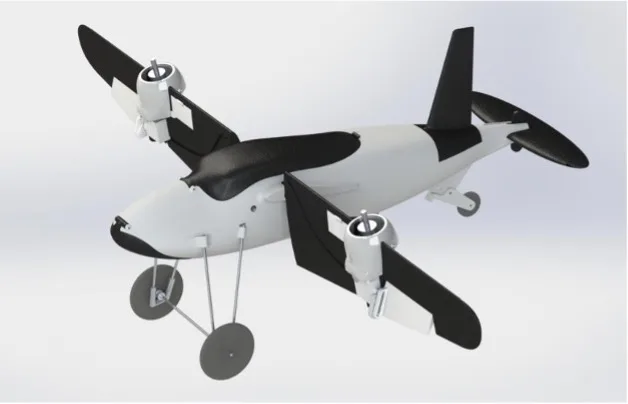
Developed a scaled tilt-wing VTOL UAV prototype at the Near East University Robotics Laboratory, serving as a research platform for transition control mechanisms. The model represents a larger design for Search and Rescue (SAR) and delivery applications, emphasizing stable hover, transition control, and SITL for efficient iteration and PID optimization.
Technologies
ROS2PythonC++MATLABFEA
Software
MATLABSolidWorksMission PlannerXFLR5ANSYS
Contributions
- Designed PID controllers for pitch and roll stabilization in hover mode
- Validated UAV aerodynamics using XFLR5
- Created SITL scenarios in MATLAB to test controllers
- Performed PID tuning and telemetry analysis
- Led mechanical design of tilt-wing chassis, including robust tilting mechanism and propeller integration for optimal actuator and sensor placement
- Conducted structural analysis using FEA to ensure airframe integrity during transitions
- Ensured modular design for easy 3D printing of parts and rapid prototyping
- Optimized wing structure for VTOL lift and forward flight efficiency
Key Features
- Adaptive PID control for multi-mode flight operations
- SITL integration for safe and efficient testing
- Tilt-wing configuration enabling seamless VTOL to horizontal flight transitions
- Robust tilting mechanism for reliable wing rotation
- Optimized propeller mounts and positioning for thrust maximization and drag minimization
- FEA-validated airframe for structural integrity during transitions
Challenges & Solutions
- Synchronizing wing tilt with attitude control during flight transitions
- Accurately modeling tilt-wing dynamics for simulation
- Designing a lightweight, sturdy airframe to house sensors, actuators, and tilt mechanisms
- Validating control systems without risking physical hardware damage
- Developing reliable tilting mechanism for smooth operation
- Optimizing wing for both VTOL lift generation and forward flight aerodynamic efficiency
- Identifying and mitigating stress points in structural design
Project Info
Timeline: January 2025 - August 2025 (8 months)
Role: Mechanical Design and Systems Engineer
Team: 3 Engineers
Status: Completed
Client: Near East University Robotics Lab (NEURL)
Impact
Key Results
- Achieved stable transitions from hover to forward flight
- Exceeded target weight-to-thrust ratio (required: 1.5:1, achieved: 1.7:1)
- Reduced hover drift by 30% from initial prototype
- Developed modular tilt-wing chassis enabling rapid prototyping
Target Audience: Aerospace engineering researchers and UAV developers
Specifications
wing Tilt Mechanism
- Tilt-wing configuration for seamless transitions between vertical and horizontal flight
- Robust tilting mechanism ensuring smooth and reliable wing rotation
- Optimized wing structure for lift in VTOL and efficiency in forward flight
propeller Integration
- Integrated propeller mounts maintaining structural integrity in all orientations
- Strategic propeller positioning and angles to maximize VTOL thrust and minimize forward flight drag
structural Analysis
- Extensive FEA to validate airframe integrity during transition phases
- Focused on identifying and mitigating potential stress points
- Ensured overall design robustness for demanding operations
scaled Model
- Accurate representation of full-size VTOL aerodynamic and structural characteristics
- Provided insights into VTOL design challenges for future developments
Software
- MATLAB
- SolidWorks
- Mission Planner
- XFLR5
- ANSYS